The Jakarta Post
Please Update your browser
Your browser is out of date, and may not be compatible with our website. A list of the most popular web browsers can be found below.
Just click on the icons to get to the download page.


Popular Reads
Top Results
No results found. Please check your search term and try again
Can't find what you're looking for?
View all search results
Popular Reads
Top Results
No results found. Please check your search term and try again
Can't find what you're looking for?
View all search resultsRI needs $10b to replace half of oil use with gas
The National Development Planning Agency (Bappenas) says about US$10 billion is needed to halve the country’s oil use, replacing it with gas
Change text size
Gift Premium Articles
to Anyone
Share the best of The Jakarta Post with friends, family, or colleagues. As a subscriber, you can gift 3 to 5 articles each month that anyone can read—no subscription needed!
 Set as preferred source

T
he National Development Planning Agency (Bappenas) says about US$10 billion is needed to halve the country’s oil use, replacing it with gas.
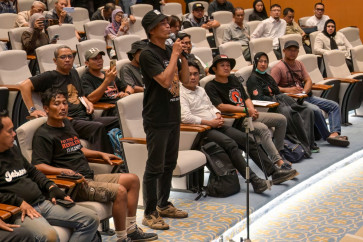
The money would be used to build basic infrastructure such as pipelines, gas stations and gas receiving terminals, Bappenas energy and natural resources chief Monti Giriana said on Wednesday
“We estimate that gas consumption in Java, the island with the highest fuel consumption in Indonesia, will jump to around 1,500 million standard cubic feet per day [mmscfd],” he told reporters on the sidelines of a meeting in Jakarta.
To meet demand Indonesia should build a pipeline between Kalimantan and Java and build more terminals to distribute liquefied natural gas (LNG) from remote plants, such as the Tangguh LNG plant in Papua, he said.
“The gas supply from Sumatra won’t be enough to meet demand in Java, so supplies from Kalimantan and Papua are very vital,” Monti said.
The investment should come from private companies or state-owned enterprises and not the state budget, according to Monti. “The government will only provide incentives to attract investors.”
The agency would also continue to study giving incentives to private car owners to use gas instead of oil-based fuels and might also give soft loans to small enterprises to manufacture kits to convert cars to gas, he said.
The kits would enable a car to use gas-based fuels such as liquefied gas for vehicles (LGV).
“To produce conversion kits makers don’t need to sophisticated technology. I believe that our small-scale industries can do that, as is done in India, so that the prices would be more affordable,” Monti said.
Evita Herawati Legowo, the oil and gas director general at the Energy and Mineral Resources Ministry, previously said that conversion kits might cost as much as Rp 10 million.
Monti said Bappenas was currently studying whether LGV or compressed natural gas (CNG) was most suitable gas-based fuel for the nation’s vehicles.
“LGV is made of liquefied natural gas [LNG]. But even now we have to import LNG. We don’t have sufficient domestic supplies. CNG will be a bit more preferable because we’ve plenty of stock from our gas fields,” he said.
Upstream oil and gas regulator BPMigas has announced that the agency will increase the domestic gas supply to 1,690.43 mmscfd in 2011, up from 1,203.18 mmscfd in 2010, as stipulated in the 2011 natural gas supply contract.
The government is eager to promote gas use for cars to reduce the consumption of subsidized fuel.
In late 2010, the government announced a plan to restrict sales of subsidized fuel starting in April in Greater Jakarta.
Under the new policy, only public transportation vehicles, motorcycles and fishermen will be access subsidized fuels.
However, due to soaring global oil prices, the government said that it might delay the implementation of the policy.
Indonesia is one of the largest gas producers but most of its gas production is mostly exported to Japan, South Korea, Taiwana and China in the form of LNG.
The LNG could not be sold in the domestic market because the absence of a receiving terminals. Many gas fields are still untapped because the lack of pipeline networks to transmit it to Java, where most of the country’s industrial gas users are based.
As the result, many industries including state owned electricity company still suffer an acute gas shortage to meet their needs.
PLN said earlier that this year it received a gas supply of only 802,74 mmscfd, far below its actual needs of around 1,800 mmscfd.